Paper on Digital Jewelery


ABSTRACT:


Mobile computing is beginning to break the chains that tie us to our desks, but many of today's mobile devices can still be a bit awkward to carry around. In the next age of computing, there will be an explosion of computer parts across our bodies, rather than across our desktops. Jewelry is worn for many reasons -- for aesthetics, to impress others, or as a symbol of affiliation or commitment. Basically, jewelry adorns the body, and has very little practical purpose. However, researchers are looking to change the way we think about the beads and bobbles we wear.

The combination of microcomputer devices and increasing computer power has allowed several companies to begin producing fashion jewelry with embedded intelligence i.e., Digital jewelry. Digital jewelry can best be defined as wireless, wearable computers that allow you to communicate by ways of e-mail, voicemail, and voice communication.

This visionary paper concentrates on how instead of one single device, eg: cell phones will be broken up into their basic components and packaged as various pieces of digital jewelry. It also enlightens on how various computerized jewelry (like ear-rings, necklace, ring, bracelet, etc.,) will work with mobile embedded intelligence. It seems that everything we access today is under lock and key. Even the devices we use are protected by passwords. It can be frustrating trying to keep with all of the passwords and keys needed to access any door or computer program. This paper discusses about a new Java-based, computerized ring that will automatically unlock doors and log on to computers.

INTRODUCTION:

May be not today, may be not tomorrow, but it will definitely come. The latest computer craze has been to be able to wear wireless computers. The Computer Fashion Wave, "Digital Jewelry" looks to be the next sizzling fashion trend of the technological wave. In the next wave of mobile computing devices, our jewelry might double as our cell phones, personal digital assistants (PDAs) and GPS receivers.

The combination of shrinking computer devices and increasing computer power has allowed several companies to begin producing fashion jewelry with embedded intelligence. Today, manufacturers can place millions of transistors on a microchip, which can be used to make small devices that store tons of digital data. Digital Jewelry appears to be one of the biggest growing promotions of its time. Imagine being able to e-mail your boss just by talking into your necklace, or by picking up messages through your watch. The whole concept behind this is to be able to communicate to others by means of wireless appliances. The other key factor of this concept market is to stay fashionable at the same time. Cellular phones are often said to be attached to our ears in this day an age. Yet they can tend to be an eye sore.


FIG:  By the end of the decade, we could be wearing our computers instead of sitting in front of them.


DEFINITION:


Digital jewelry is the fashion jewelry with embedded intelligence.  “Digital jewelry” can help you solve problems like forgotten passwords and security badges. These devices have a tiny processor and unique identifiers that interact with local sensors. “Digital jewelry” is a nascent catchphrase for wearable ID devices that contain personal information like passwords, identification, and account information. They have the potential to be all-in-one replacements for your driver’s license, keychain, business cards, credit cards, health insurance card, corporate security badge, and loose cash. They can also solve a common dilemma of today’s wired world – the forgotten password.

HOW DIGITAL JEWELRY WORKS:


Soon, cell phones will take a totally new form, appearing to have no form at all. Instead of one single device, cell phones will be broken up into their basic components and packaged as various pieces of digital jewelry. Each piece of jewelry will contain a fraction of the components found in a conventional mobile phone. Together, the digital-jewelry cell phone should work just like a conventional cell phone.
The various components that are inside a cell phone:
Microphone,
Receiver,
Touch pad,
Display,
Circuit board,
Antenna,
Battery.
IBM has developed a prototype of a cell phone that consists of several pieces of digital jewelry that will work together wirelessly, possibly with Bluetooth wireless technology, to perform the functions of the above components.
    Here are the pieces of computerized-jewelry phone and their functions:

  • Earrings - Speakers embedded into these earrings will be the phone's receiver.

  • Necklace - Users will talk into the necklace's embedded microphone.

  • Ring - Perhaps the most interesting piece of the phone, this "magic decoder ring” is equipped with light-emitting diodes (LEDs) that flash to indicate an incoming call. It can also be programmed to flash different colors to identify a particular caller or indicate the importance of a call.

  • Bracelet - Equipped with a video graphics array (VGA) display, this wrist display could also be used as a caller identifier that flashes the name and phone number of the caller.
With a jewelry phone, the keypad and dialing function could be integrated into the bracelet, or else dumped altogether -- it's likely that voice-recognition software will be used to make calls, a capability that is already commonplace in many of today's cell phones. Simply say the name of the person you want to call and the phone will dial that person. IBM is also working on a miniature rechargeable battery to power these components. 


In addition to changing the way we make phone calls, digital jewelry will also affect how we deal with the ever-increasing bombardment of e-mail. Imagine that the same ring that flashes for phone calls could also inform you that e-mail is piling up in your inbox. This flashing alert could also indicate the urgency of the e-mail. Two of the most identifiable components of a personal computer are the mouse and monitor. These devices are as familiar to us today as a television

 set.

FIG: The eyepiece above displays images and data received wirelessly from the Communicator's belt module.


The mouse-ring that IBM is developing will use the company's Track Point technology to wirelessly move the cursor on a computer-monitor display. You're probably most familiar with Track Point as the little button embedded in the keyboard of some laptops. IBM Researchers have transferred Track Point technology to a ring, which looks something like a black-pearl ring. On top of the ring is a little black ball that users will swivel to move the cursor, in the same way that the Track Point button on a laptop is used.
This Track Point ring will be very valuable when monitors shrink to the size of watch face. In the coming age of ubiquitous computing, displays will no longer be tied to desktops or wall screens. Instead, you'll wear the display like a pair of sunglasses or a bracelet. Researchers are overcoming several obstacles facing these new wearable displays, the most important of which is the readability of information displayed on these tiny devices

.


FIG: IBM has developed a prototype bracelet display

Charmed Technology is already marketing its digital jewelry, including a futuristic-looking eyepiece display. The eyepiece is the display component of the company's Charmed Communicator, a wearable, wireless, broadband-Internet device that can be controlled by voice, pen or handheld keypad. The Communicator can be used as an MP3 player, video player and cell phone. The Communicator runs on the company's Linux-based Nanix operating system.

OTHER DESIGNS AVAILABLE:

      GARNET-RING:


The picture above is of a ring containing a microprocessor. It vibrates to let you know that you have received a message from someone.


GARNET BROACH:


Above is a picture of a garnet broach containing a microphone. This enables you to record messages just by pressing a small button on the side.


RED RUBY NECKLACE


The necklace to the left would have a microphone built in. All you would need to do to use it press a small button in the back. Then you can proceed to record your message.


THE JAVA RING:


It seems that everything we access today is under lock and key. Even the devices we use are protected by passwords. It can be frustrating trying to keep with all of the passwords and keys needed to access any door or computer program. Dallas Semiconductor is developing a new Java-based, computerized ring that will automatically unlock doors and log on to computers.


FIG: The Java Ring can be programmed to give you access to every door and device.


The Java Ring, first introduced at Java One Conference, has been tested at Celebration School, an innovative K-12 school just outside Orlando, FL. The rings given to students are programmed with Java applets that communicate with host applications on networked systems. Applets are small applications that are designed to be run within another application. The Java Ring is snapped into a reader, called a Blue Dot receptor, to allow communication between a host system and the Java Ring.

The Java Ring is a stainless-steel ring, 16-millimeters (0.6 inches) in diameter, which houses a 1-million-transistor processor, called an iButton. The ring has 134 KB of RAM, 32 KB of ROM, a real-time clock and a Java virtual machine, which is a piece of software that recognizes the Java language and translates it for the user's computer system.

Mobile computing is beginning to break the chains that tie us to our desks, but many of today's mobile devices can still be a bit awkward to carry around. In the next age of computing, we will see an explosion of computer parts across our bodies, rather than across our desktops. Digital jewelry, designed to supplement the personal computer, will be the evolution in digital technology that makes computer elements entirely compatible with the human form.

TECHNICAL SPECIFICATIONS OF DIGITAL JEWELRY:


Digital jewelry devices consist of a screen or display for information, most likely consisting of 7-16-segment, or dot matrix LEDs, LCDs, or other technologies such as electroluminescent material (EL) or others, which could become an optional display. So too, an audiovisual or other 'display' could consist of a speaker, a single flashing light, a sensor of some kind (such as a temperature driven EL display), or other informational aesthetic. The display layer (d) sits on a face of the device, which is enclosed in some material such as plastic, metal, crystal, or other material. It has external switches and buttons on its side and a data-port for accessing the programmable electronic circuit inside. A microcontroller that is a surface mounted device (SMD) on a printed circuit board (PCB) with resistors (R) and capacitors (C) are the internal 'guts' of the jewelry.

DISPLAY TECHNOLOGIES:

The digital jewelry display, for instance, every alphabet and number system has found representation within the electronics realm and 'dot-matrix' (a matrix of single LEDs) is used to display Chinese and Japanese and other character sets, as can the alternative display for LCDs (liquid-crystal-displays) also be used, as often found in watches, given the specifications and uses for the EMJ device and its design parameters.

The digital jewelry display itself can be both an illuminated symbol and an information device, or one or another conception and form factor. For educational purposes though, a device, which can display alpha numeric, is of prime importance to basic literacy of how numbers, letters, code, and electronics find their integration in a cultural device.

Digital Jewelry can be made in many different sizes and shapes with a variety of materials ranging from plastic and metal to rubber and glass. They utilize electromagnetic properties and electronics to display information through a screen or display of some kind. This could range from LED 7-segment, 16-segment, dot matrix, and other programmable LEDs devices to LCDs, OLEDs, and other displays, which are all driven by the self-contained jewelry devices themselves.


The Digital jewelry devices can also have multiple-functions as both wearable art and even as a type of communication device with infrared (IR) transmission and reception displays.

ELECTROMAGNETIC BEADS:


The closest comparison to this model is that of 'beads' which are strung together to make a custom necklace or bracelet, with interchangeable electromagnetic component systems or devices. One bead may be a capacitor on the inside, and a solar panel on the outside (1), another bead may have an internal resistor (2), which feed power into a programmed microcontroller bead which drives an external screen (3), with other options available in a variety of bead configurations which compose a circuit, including beads with a piezo element (4), voltage regulator, crystal, or rechargeable battery (5) as part of the modular jewel circuit.

The number of data pins on the microcontroller needs to be enough to easily program the display layer plus the switches without overly complex and advanced coding methods


FIG: The key to the device's ability to work effectively is a balancing of electronic components within the circuit with a light-duty processing and limited power consumption required for the display (d) layer


r


PROTOTYPES OF DIGITAL JEWELRY

:

 FIG:  Complete HIOX necklace showing all 26 letters of the Roman alphabet extended in 4-dimensional space-time. Metal with leather cord

.


FIG: Programmable HIOX ring with 16-segment LED display


CONCLUSION:


Digital jewelry can best be defined as wireless, wearable computers that allow you to communicate by ways of e-mail, voicemail, and voice communication. The jewelry pieces work as a set. For example, imagine that your set consists of earrings, a necklace, and a watch. You can pick-up your messages and display them on your watch. In order to hear the message, if it's a voice message, you can listen to it in your earrings. If you want to send out a message, you can talk into your necklace and it will allow you send a voice message. The works much like that of a cellular phone. It does almost all the same functions but looks nicer. Each piece has a small button on the backside of the accessory that when pressed activates the piece. You then use each piece accordingly. You may also, once marketed, choose to buy extra pieces for the set. This may include a ring that has a vibrating chip in it. The ring would vibrate to inform you of any incoming messages.
    The basic idea behind the digital jewelry concept is to have the convenience of wireless, wearable computers while remaining fashionably sound. It is hoped to be marketable soon, however, several bugs remain. Charging capabilities and cost are just a sample of the problems that lurk
BIBLIOGRAPHY:      
  1. www.howstuffworks.com
  2. www.IBM.com
  3. www.infoworld.com
  4. www.ibutton.com
  5. www.honey1411.tripod.com


Paper on Global Positioning System


ABSTRACT
                      
                      The ability to locate oneself on the earth and in its vicinity and navigate over its surface is knowledge that has fascinated humankind for these millennia. All the techniques available that implement the above mentioned core theme use, “GLOBAL POSITIONING SYSTEM” (GPS), which has become a vital global utility, indispensable for modern navigation on land, sea, and air around the world, as well as an important tool for Map-Making and Land Surveying.         
                                      
                    This paper provides description of all the technical aspects of GPS along with techniques to improve the accuracy of the system. It also deals with some of very important GPS applications like vehicle tracking, mobile tracking, in agriculture, in geology etc towards the end.


Index Terms
Doppler distortion, Ephemeris errors, Navigation signal, Line of sight, Navigation message, y-code, Almanac, Jamming.


INTRODUCTION


                      GPS is a space-based radio positioning system that provides 24*7 three-dimensional positions, velocity and time information to suitably equipped users anywhere on or near the surface of the earth and sometimes off the earth.

                     It consists of a network of twenty four orbiting satellites that are orbiting in space eleven thousand miles from earth and a GPS receiver includes an antenna adapted to receive GPS satellite signals from each of the GPS satellites. There is navigation solution determining circuitry coupled to the antenna that receives the GPS satellite signals and performs navigation and fault detection and exclusion functions. The GPS satellites are orbited high enough to avoid problems associated with land based systems, yet can provide accurate positioning twenty four hours a day, anywhere in the world.


HOW DOES GPS WORK?


GPS Constellation:


                    There are at least twenty four operational GPS satellites at all times which orbit with a time period of twelve hours. Ground stations are used to precisely track each satellite's orbit. Each GPS satellite transmits data that indicates its location and the current time. All GPS satellites synchronize operations so that these repeating signals are transmitted at the same instant. The receiver calculates position of the satellites in three dimensions if the distance to at least four GPS satellites is known.

                   The following figure shows the GPS constellation with all the 24 satellites revolving in their respective orbits.


Satellites:

                    As of august 2006 the GPS system used a satellite constellation of 24 active Block -M satellites for the global coverage in intermediate circular orbits. There are three spare satellites in orbit, in case of any failure. Each satellite circles the earth twice each day at an altitude of 20,200 kilometers. The orbits are aligned so that at least four satellites are always within line of sight from almost any place on earth.

                   The flight paths of the satellites are measured by five monitor stations around the world which are Hawaii, Kwajalein, Ascension Island, Diego Garcia, Colorado Springs and the master control station, at Schriever Air Force Base.

The Frequencies Used:

                    The frequencies that make up the GPS electromagnetic spectrum are L1 (1575.42 MHz), L2 (1227.60 MHz), L3 (1381.05 MHz) with two new signals L4 (1841.40 MHz), L5 (1176.45 MHz) also being studied.

Receivers:


                    GPS receivers vary widely in accuracy because of the expense of adding more radio receivers needed to tune in more satellites. More expensive units, known as "dual-frequency receivers", tune in the L2 signals in order to correct for ionospheric delays.

                     Another major factor in the accuracy of a GPS fix is the amount of processing applied to the received signals. GPS receivers may include an input for differential corrections, using the RTCM SC-104 format. Receivers with internal DGPS receivers can outperform those using external RTCM data. Many GPS receivers can relay position data to a PC or other device using the NMEA 0183 protocol. Receivers can interface with external devices via a number of means, such as a serial connection, a USB connection or even a wireless connection like the BLUETOOTH technology.

Navigation Signals:

                GPS satellites transmit signals to equipment on the ground. GPS receivers passively receive satellite signals but do not transmit. GPS receivers require an unobstructed view of the sky, so they are used only outdoors and they often do not perform well within forested areas or near tall buildings.

              GPS satellites broadcast three different types of data in the primary navigation signals. The first is the almanac which sends coarse time information with second precision along with status information about the satellites.

              The second is the ephemeris, which contains orbital information that allows the receiver to calculate the position of the satellite at any point in time. These bits of data are folded into the 37,500 bit Navigation Message.

             The satellites also broadcast two forms of accurate clock information, the Coarse Acquisition code and the precise code. In normal operation, the so-called "anti-spoofing mode", the P code is first encrypted into the Y-code.

            The following figure gives an overview of how the GPS works. It includes the spacecraft constellation, master control system and the signal structure
           

Calculating Positions:         
       
                     In a nutshell, GPS is based on satellite ranging - calculating the distances between the receiver and the position of satellites. The receivers measure the time delay between when the signal is sent and the local time when the signal is received. This delay, multiplied by the speed of light, gives the distance to that satellite.

                   The receiver now has an accurate estimate of the position and the distance of the satellite. This tells the receiver that it lies on the surface of an imaginary sphere whose radius is that distance. To calculate the precise position, at least four such measurements are taken simultaneously. This places the receiver at the intersection of the four imaginary spheres as shown in the figure below


.

Accuracy:
                     The accuracy of position calculated by a GPS receiver relies on three accurate measurements: the current time, the position of the satellite, and the time delay for the signal. However, several "real world" effects intrude and degrade the accuracy of the system as shown in the table.
Source                            Effect
Ionospheric effects         ± 5 meter
Ephemeris errors            ± 2.5 meter
Satellite clock errors      ± 2 meter
Multipath distortion       ± 1 meter
Tropospheric effects      ± 0.5 meter
Numerical errors            ± 1 meter or less


Techniques to Improve Accuracy:


                    There are various methods available which improve the accuracy to a great extent.
                     Differential GPS used by receivers which can improve the normal GPS accuracy of 4-20 meters to 1-3 meters.
                     Wide Area Augmentation System is used in case of ionospheric delays. This system uses a series of ground reference stations to calculate GPS correction messages, which are uploaded to a series of additional satellites in geosynchronous orbit.
                     A Local Area Augmentation System is similar to WAAS but in this case, the correction data are transmitted from a local source, typically at an airport or another location where accurate positioning is needed. These correction data are typically useful for only about a thirty to fifty kilometer radius around the transmitter.
                    A Carrier-Phase Enhancement utilizes the 1.575 GHz L1 carrier wave to act as a sort of additional clock signal, resolving ambiguity caused by variations in the location of the pulse transition (logic 1-0 or 0-1) of the C/A signal.
                   Wide Area GPS Enhancement which provides more accurate satellite clock and ephemeris data to specially-equipped receivers.


GPS APPLICATIONS


                      GPS can provide any point on earth with a unique address and hence finds its greatest utility in the field of Geographic Information Systems (GIS). However GPS is not just confined to GIS but is widely being used in many other areas as well.

GPS for GIS:

                     After GPS determines a location on the surface of the earth, we shall know what is at that location. The word "what" is the object or objects which will be mapped referred to as "Features", and are used to build a GIS. It is the power of GPS to precisely locate these Features which adds so much to the utility of the GIS system.

                    There are three types of Feature which can be mapped: Points, Lines and Areas which correspond to a single GPS coordinate position, a collection of GPS positions and those with lines tied to each other to form a closed area respectively.

                   Additional information such as color, size, cost, occupants, etc are provided which are used to sort and classify a feature and are known as Attributes.

                    A Feature List is a database which contains a listing of the Features which will be mapped, as well as the associated Attributes for each Feature. When a Feature List is used in the field, the first step is to select the Feature to be mapped. Once a Feature is selected, the Attributes for that Feature are automatically listed.

                  The final step in incorporating GPS data with a GIS system is to export the GPS and Feature data into the GIS system. During this process, a GIS "layer" is created for each Feature in the GPS job.

Earthquake Detection:

                     The satellites in the constellation are arranged so that several of them are "visible" from any point on the surface of the earth at any time. The GPS network will continuously measure movements of the earth's crust with a precision of one millimeter per year, which will show us where strain is building up and the receivers that will continuously measure the constant, yet physically imperceptible, movements of earthquake faults. Scientists face lot of difficulty to rapidly assess the size of large earthquakes but, GPS-based detection offers the most advantages even when an earthquake has a magnitude of 8.5.


                    Not only earthquakes but, scientists can now estimate an earthquake’s potential for causing a tsunami using deep ocean buoy readings and seismometer data.  

A new tsunami-detection technique that uses GPS data could potentially save many lives by helping alert people in time to escape.

Precise Time Reference:

                      Many systems that must be accurately synchronized use GPS as a source of accurate time. For instance, the GPS can be used as a reference clock for time code generators or NTP clocks. The atomic clocks on the satellites are set to "GPS time". GPS time is counted in days, hours, minutes, and seconds, in the manner that is conventional for most time standards. Communications networks often rely on this precise timing to synchronize RF generating equipment, network equipment, and multiplexers.

Military:

                     GPS allows accurate targeting of various military weapons including cruise missiles and precision-guided munitions, as well as improved command and control of forces through improved location awareness. The satellites also carry nuclear detonation detectors, which form a major portion of the United States Nuclear Detonation Detection System. Most effective use of GPS in military can be seen in jamming of any radio navigation system.


Agriculture:


                      GPS is used for the guidance of tractors and other large agricultural machines via auto steer or a visual aid displayed on a screen, which is extremely useful for controlled traffic and row crop operations and when spraying.

                     Further its applications include precision agriculture, site-specific farming and prescription farming. GPS applications in farming include guidance of equipment such as sprayers, fertilizer applicators and tillage implements to reduce excess overlap and skips. They can also be used to precisely locate soil-sampling sites, map weed, disease and insect infestations in fields and apply variable rate crop inputs, and, in conjunction with yield monitors, record crop yields in field

Surveying:

                    More costly and precise receivers are used by land surveyors to locate boundaries, structures, and survey markers, and for road construction. There is also a growing demand for Automatic Grade Control systems that use GPS positions and 3D site plans to automatically control the blades and buckets of construction equipment.

Navigation:

                    GPS is used by people around the world as a navigation aid in cars, airplanes, and ships. Hand-held GPS receivers can be used by mountain climbers and hikers. Glider pilots use the logged signal to verify their arrival at turn points in competitions.

Vehicle Tracking:

                   
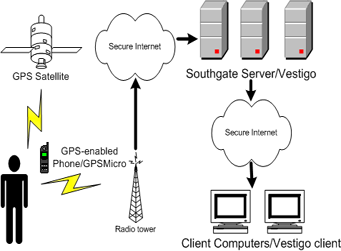
                    A GPS tracking system uses GPS to determine the location of a vehicle, person, or pet and to record the position at regular intervals in order to create a track file or log of activities. The recorded data can be stored within the tracking unit, or it may be transmitted to a central location, or Internet-connected computer, using a cellular modem,


2-way radio or satellite. This allows the data to be reported in real-time; using either web browser based tools or customized software.


Mobile Phone Tracking:

                    This is ideal for business especially if its mobile, what you need is mobile phone tracking which is simple and easy to use and can be set up in minutes. Unlike vehicle tracking, mobile tracking also means one can continue to track, even when the employee has left their car or van. This allows you to monitor the work force every minute, any time, day or night to improve business efficiency.

                   Interestingly, mobile phone tracking can be extended to track where a person is, by triangulating his position between cells, track which cell he is entering by knowing the cell from which he enters.

               GPS is a great system to use, especially with the event of GPS receivers becoming smaller and smaller and better GPS software coming out and providing more accurate tracking for the user who needs to track more frequently. The following suggest a clear description of the whole process of tracking that takes place.


Geophysics and Geology:

                     High precision measurements of earth’s crustal strain can be made with GPS by finding the relative displacement between GPS sites, one of which is assumed to be stationary. Multiple stations situated around an actively deforming area (such as a volcano or fault zone) can be used to find strain and site velocities relative to a stable reference site. For example, measurements of ground deformation around a volcano can be used to interpret the source and cause—a dike, sill, or other body beneath the surface.
Entertainment:

                 The availability and cost of hand-held GPS receivers has led to recreational applications including location-based games like the popular game Geocaching.

CONCLUSION

             GPS is the product of a long and complicated history and has brought many changes in the society since then. It has increasingly become more evident in society through its implementation into items such as vehicles, mobile phones and pet collars. The economics of GPS make the measurement technology readily available and accessible to all users. Many issues surround GPS when it comes to its future. The most certain aspect of the future of GPS is its increased usage and its expansion into new areas of application.

                  We have seen that GPS setup could be just the one we may need for the PDA devices which are considered to be using the latest technology as on today. Thus, what one can conclude is that GPS will continue to intrude into many other fields and will be an evergreen technology for many more years to come.


REFERENCES

  • The Global Positioning System: Challenges in GPS - Article by Kanwar Chadha.
  • Global Positioning System Overview by Peter H. Dana.
  • GPS Satellite Surveying, by Wiley & Sons.

Newer Posts Older Posts Home

Followers

Mi perfil

My photo
People who read my blog regularly know what kinda person I am. For others who don't - I'm an information junkie..who likes to dig deep into things to find out what's happening in the world of education, business and management. I like investing in shares. I'm kinda sociable person - I go well with all kinda ppl..It's all about passion :)

Recent Comments