DRIVING WITHOUT WHEELS, FLYING WITHOUT WINGS

ABSTRACT
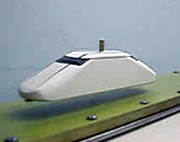
This paper “Driving without wheels, Flying without wings” deals with the present scenario of magnetic levitation (maglev) with Linear induction motor (LIM) .The magnetically levitated train has no wheels, but floats-- or surfs-- on an electromagnetic wave, enabling rides at 330 miles per hour. By employing no wheels, maglev eliminates the friction, and concomitant heat, associated with conventional wheel-on-rail train configurations. There are two basic types of non-contact Maglev systems Electro Dynamic Suspension (EDS), and Electro Magnetic Suspension (EMS). EDS is commonly know as "Repulsive Levitation," and EMS is commonly known as "Attractive Levitation." Each type of Maglev system requires propulsion as well as "levitation." The various projects above use different techniques for prpulsion, but they are all variations of the Linear Induction Motor (LIM) or Linear Synchronous Motor (LSM).The conversion to a linear geometry has a far greater effect on induction motor performance than on that of synchronous motors. The cost of making the guideway is a high percentage of the total investment for a maglev system. The comparison looks even better for maglev when the terrain becomes difficult. Many of the tunnels, embankments, and cuttings necessary for roads and railroads are avoided because maglev guideways can be easily adapted to the topography. The Maglev system requires a slightly larger start-up capital construction cost, its operating cost-- because it deploys electricity in electromagnets in an extraordinarily efficient manner, rather than using as a fuel source coal, gas or oil-- can be one-half that of conventional rail. The crucial point is that maglev will set off a transportation and broader scientific explosion.
Key words: Magnetic levitation , Levitation , Propulsion , Linear induction motor(LIM).
INTRODUCTION
Air flights are and will remain beyond the reach of a major section of society, particularly in India. Moreover there are problems of wastage of time in air traffic delays and growing safety concerns. Trends in increased mobility of large masses with changing lifestyle for more comfort are leading to congestion on roads with automobiles. Besides, increasing pollution levels from automobiles, depleting fuel resources, critical dependence on the fuel import and due to a limited range of mobility of buses and cars the need for fast and reliable transportation is increasing throughout the world. High-speed rail has been the solution for many countries. Trains are fast, comfortable, and energy-efficient and magnetic levitation may be an even better solution.
Development of magnetic levitated transport systems is under progress in developed countries and it is just a matter of time they make inroads to India as well. Therefore, it will be interesting to know about the science and technology behind mass ground transport system known as "magnetic flight".
Magnetic levitation
Magnetic levitation is the use of magnetic fields to levitate a (usually) metallic object. Manipulating magnetic fields and controlling their forces can levitate an object. In this process an object is suspended above another with no other support but magnetic fields. The electromagnetic force is used to counteract the effects of gravitation. . The forces acting on an object in any combination of gravitational, electrostatic, and magnetostatic fields will make the object's position unstable. The reason a permanent magnet suspended above another magnet is unstable is because the levitated magnet will easily overturn and the force will become attractive. If the levitated magnet is rotated, the gyroscopic forces can prevent the magnet from overturning. Several possibilities exist to make levitation viable.
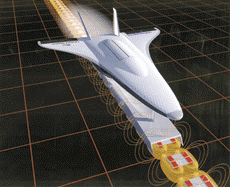
It is possible to levitate superconductors and other diamagnetic materials, which magnetize in the opposite sense to a magnetic field in which they are placed. A superconductor is perfectly diamagnetic which means it expels a magnetic field (Meissner-Ochsenfeld effect). Other diamagnetic materials are common place and can also be levitated in a magnetic field if it is strong enough. Diamagnetism is a very weak form of magnetism that is only exhibited in the presence of an external magnetic field. The induced magnetic moment is very small and in a direction opposite to that of the applied field. When placed between the poles of a strong electromagnet, diamagnetic materials are attracted towards regions where the magnetic field is weak. Diamagnetism can be used to levitate light pieces of pyrolytic graphite or bismuth above a moderately strong permanent magnet. As Superconductors are perfect diamagnets and when placed in an external magnetic field expel the field lines from their interiors (better than a diamagnet). The magnet is held at a fixed distance from the superconductor or vice versa. This is the principle in place behind EDS (electrodynamic suspension) maglev trains. The EDS system relies on superconducting magnets.
A maglev is a train, which is suspended in air above the track, and propelled forward using magnetism. Because of the lack of physical contact between the track and vehicle, the only friction is that between the carriages and air. So maglev trains can travel at very high speeds (650 km/h) with reasonable energy consumption and noise levels.
levitation
Each type of Maglev system requires propulsion as well as "levitation." The various projects below use different techniques for propulsion. The first thing a maglev system must do is get off the ground, and then stay suspended off the ground. This is achieved by the electromagnetic levitation system.
The principal two systems: EMS- attractive and EDS-repulsive, respectively.

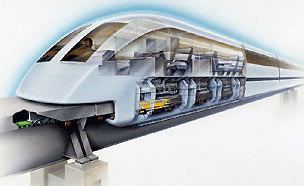
In the EMS-attractive system, the electromagnets which do the work of levitation are attached on the top side of a casing that extends below and then curves back up to the rail that is in the center of the track. The rail, which is in the shape of an inverted T, is a ferromagnetic rail. When a current is passed through it, and the electromagnet switched on, there is attraction, and the levitation electromagnets, which are below the rail, raise up to meet the rail. The car levitates. The gap between the bottom of the vehicle and the rail is only 3/8" and an electronic monitoring system, by controlling the amount of attractive force, must closely control the size of the gap.
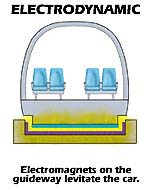
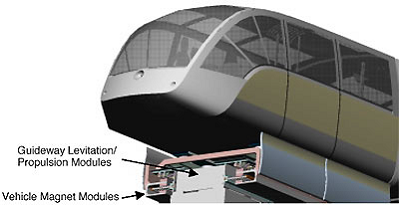
In the EDS-repulsive system, the superconducting magnets (SCMs), which do the levitating of the vehicle, are at the bottom of the vehicle, but above the track. The track or roadway is either an aluminum guideway or a set of conductive coils. The magnetic field of the superconducting magnets aboard the maglev vehicle induces an eddy current in the guideway. The polarity of the eddy current is same as the polarity of the SCMs onboard the vehicle. Repulsion results, "pushing" the vehicle away and thus up from the track. The gap between vehicle and guideway in the EDS-system is considerably wider, at 1 to 7 inches, and is also regulated (by a null-flux system). Thus, the guideway is not below, but out to the sides. Now the repulsion goes perpendicularly outward from the vehicle to the coils in the guidewalls. The perpendicular repulsion still provides lift.
they are all variations of the Linear Induction Motor (LIM) or Linear Synchronous Motor (LSM).
Choice of linear electric motor
A linear electric motor (LEM) is a mechanism which converts electrical energy directly into linear motion without employing any intervening rotary components. The development of one type of LEM,
Linear synchronous motor (LSM), is illustrated in graphic form in Figure IV-1. A conventional
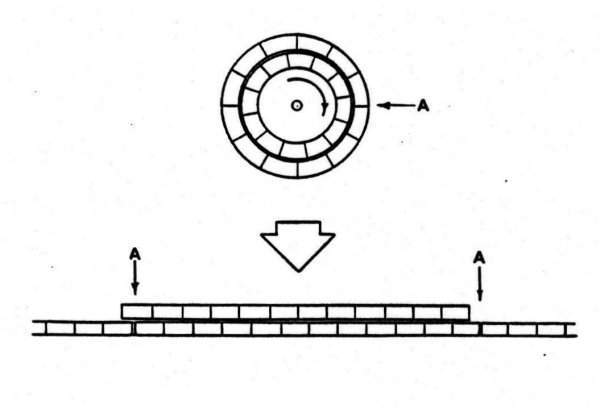
rotary synchronous motor (above), such as that powering an electric clock, is made up of two rings of alternating north and south magnetic poles. The outer ring (the stator) is stationary, while the inner one (the rotor) is free to rotate about a shaft. The polarity of the magnets on one (either) of these rings is fixed; this element is known as the field. The magnets of the other ring, the armature, change their polarity in response to an applied alternating current. Attractive forces between unlike magnetic poles pull each element of the rotor toward the corresponding element of the stator. Just as the two poles are coming into alignment, the polarity of the armature magnets is reversed, resulting in a repulsive force that keeps the motor turning in the same direction. The armature poles are then reversed again, and the motor turns at a constant speed in synchronism with the alternating current which causes the change in polarity
Linear Induction Motor (LIM) is basically a rotating squirrel cage induction motor opened out flat. Instead of producing rotary torque from a cylindrical machine it produces linear force from a flat one. It is not a new technology but merely design in a different form. Only the shape and the way it produces motion is changed. But there are advantages: no moving parts, silent operation, reduced maintenance, compact size, ease of control and installation. LIM thrusts vary from just a few to thousands of Newtons, depending mainly on the size and rating. Speeds vary from zero to many meters per second and are determined by design and supply frequency. Speed can be controlled by either simple or complex systems. Stopping, starting, reversing, are all easy.
LEM's have long been regarded as the most promising means of propulsion for future high-speed ground transportation systems. The proposed system, while not strictly qualifying as high-speed, still derives so many advantages from the utilization of an LEM that no other propulsion means is being considered at this stage.
Within the broad range of possible LEM designs, many alternatives are available. The selection of the preferred configuration can perhaps best be understood through a discussion of the choices considered and the reasons for the rejection of the others.
1. Synchronous vs. induction motors. Far more effort has been put into research and development of linear induction motors (LIM's) than LSM's. LIM's do indeed have two distinct advantages. First of all, they are simpler and less costly to construct. The stationary element of the motor consists of nothing more than a rail or plate of a conducting material, such as aluminum. Alternating current applied to the coils of the moving electromagnets induces a fluctuating magnetic field around this conductor which provides the propulsive force. By contrast, LSM's require the installation of alternating north and south magnetic poles on both moving and stationary elements. Secondly, LIM's are self-starting, with the speed of motion being infinitely variable from zero up to the design maximum. LSM's, on the other hand, exhibit no starting torque; rotary motors of this type are generally equipped with auxiliary squirrel-cage windings so that they can act as induction motors until they reach operating speed.
LSM's possess other advantages, however, which are more than sufficient to outweigh these faults. They are far more efficient; models have been built with efficiencies of 97% or more, whereas the highest value yet attained for an LIM scarcely exceeds 70%. This is true despite the fact that rotary synchronous motors enjoy only a slight efficiency advantage over rotary induction motors; apparently the conversion to a linear geometry has a far greater effect on induction motor performance than on that of synchronous motors. Moreover, the efficiency of an LSM is relatively unaffected by the speed of travel; LIM's, on the other hand, do not reach peak efficiencies until they attain velocities which are well beyond those being considered here.
An LSM also operates at a constant speed, which depends solely on the frequency of the alternating current applied to its armature. This feature offers opportunities for absolute speed control; under normal operation, there is no way for any moving conveyance to alter its prescribed position relative to that of any other vehicle on the track. This fact imparts to any ground transportation system employing LSM's an enormously high traffic capacity, many times greater than the maximum attainable using LIM's. The proposed system demands such a capacity if it is to fulfill its goal of providing the opportunity for individual travel from any point on the system to any other, and at any time, day or night. Reciprocally, it is this potential for carrying huge volumes of traffic, made up of both public and private vehicles and of both passengers and cargo, that can justify the extra expenditure needed for the construction of an LSM-powered system.
Linear induction motor(LIM) in magnetic levitation
The High Speed Surface Transport (HSST) sysem is propelled by linear induction motor.The HSST primary coils are attached to the carriag body and the track configuration is simple, using the steel rails and aluminum reaction plates.The HSST levitation system uses ordinary electromagnets that excerts an attractive force and levitate the vehicle.The electromagnetsare attached to the car, but are positioned facing the under side of the guide way's steel rails.They provide an attractive force from brlow,levitating the car.
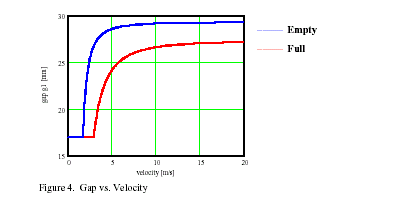
This attractive force is controlled by a gap sensor that measures the distance brtween the rails and electromagnets. A control circuit continually regulates the current to the electromagnet , ensuring that the gap remains at a fixed distance of about 8 mm, the current is decreased. This action is computer controlled at 4000 times per second to ensure the levitation.
As shown in figure, the levtation magnets and rail are both U shaped (with rail being an inverted U ). The mouths of U face one another. This configuation ensures that when ever a levitational force is excerted, a lateal guidance force occurs as well. if the electromagnet starts to shift laterally from the center of the rail, the lateral guidance force is excerted in proportion to the extent of the shift , bringing the electromagnet back into alignment. Theuseofanelecromagnetic attractive force to both levitatie and guide the car is a significant feature of HSST the system
we cna visulize an HSST linear motor as an ordinary electric induction motor that has been split open and flattend. This of linear motor has recently been used in various fields the fig illustrates in the HSST, the primary side coils of motor are attached to the car body in the secondary side reaction plates are installed along the guide way .this component acts as induction motor and ensures both propulsion and breaking force without any contact between car and guide way. This system a car mounted primary linear induction system. The ground side requires only a steel plate backed by an aluminum or copper plate, meaning that the rail source is simple.
one of the HSST's unique technical features is modules that correspond to the bogies on conectional rolling stock. Figure shows each consists primarly of a member of electromagnets for levitation guidance, a linear motor for propulsion and braking, and a hydraulic break system.
The two modules on the left and right sides of the car connected beams and this unit is called levitation bogie because the levitation bogies run the entire length of the car, the load car and load on guide way are spread out and the advantages of magnetic levitation can be fully exploited.
Characteristics of LIM
In most vehicular propulsion systems, provision must be made for increasing the power when the demand increases due to acceleration, a heavier load, increased drag, headwinds, or climbing a hill. In the case of an automobile, this is done through manipulation of both the accelerator and the transmission. But all of this is accomplished automatically when an LIM is used. Whenever more power is needed, the moving magnet begins to lag further behind the stationary one; this results in an immediate increase in thrust. No separate control is needed.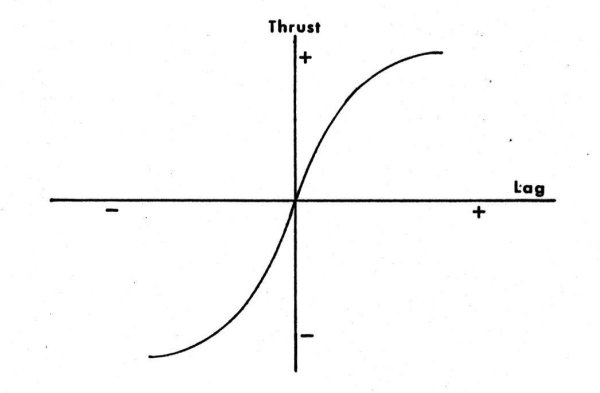
Moreover, when an LIM-powered vehicle descends a steep hill or decelerates into a station, the moving motor advances to a position where it leads the stationary one. Under these conditions, the motor performance is shown in the left half of Figure. This automatically results in the production of electrical energy which is fed back into the system with a frequency and phase coherent with the line voltage. In other words, LIM's are automatically regenerative.
REQUIREMENTS OF AN URBAN MAGLEV

A thorough requirements document should be prepared during the initial stage of the program. This document creates a common set of guidelines, which is intended to keep the design team focused during the design/development process. Included are requirements for the system and major subsystems to assure the performance, ride comfort and safety of the passengers.
Benefits of Magnetic Levitated Transportion system
* Unlike conventional transportation systems in which a vehicle has to carry the total power needed for the most demanding sections, the power of the maglev motor is dependent on the local conditions such as flat or uphill grades.
* Maglev uses 30% less energy than a high-speed train travelling at the same speed (1/3 more power for the same amount of energy).
* The operating costs of a maglev system are approximately half that of conventional long-distance railroads.
* Research has shown that the maglev is about 20 times safer than airplanes, 250 times safer than conventional railroads, and 700 times safer than automobile travel.
* Despite the speeds up to 500 km/hour, passengers can move about freely in the vehicles at all times.
* Maglev vehicle carries no fuel to increase fire hazard
* The materials used to construct maglev vehicles are non-combustible, poor transmitters of heat, and able to withstand fire penetration.
* In the unlikely event that a fire and power loss occurred simultaneously, the vehicle is automatically slowed down so that it stops at a predefined emergency power station.
* A collision between two maglev trains is nearly impossible because the linear induction motors prevent trains running in opposite directions or different speeds within the same power section.
Current Projects
Germany and Japan have been the pioneering countries in MagLev research. Currently operational systems include Transrapid (Germany) and High Speed Surface Transport (Japan). There are several other projects under scrutiny such as the SwissMetro, Seraphim and Inductrack. All have to do with personal rapid transit.
Other Applications
NASA plans to use magnetic levitation for launching of space vehicles into low earth orbit.Boeing is pursuing research in MagLev to provide a Hypersonic Ground Test Facility for the Air Force. The mining industry will also benefit from MagLev. There are probably many more undiscovered applications!
CONCLUSION
The MagLev Train: Research on this ‘dream train’ has been going on for the last 30 odd years in various parts of the world. The chief advantages of this type of train are: 1. Non-contact and non-wearing propulsion, independent of friction, no mechanical components like wheel, axle. Maintenance costs decrease. Low noise emission and vibrations at all speeds (again due to non-contact nature). Low specific energy consumption. Faster turnaround times, which means fewer vehicles. All in all, low operating costs.Speeds of upto 500kmph..Low pollutant emissions. Hence environmentally friendly
The MagLev offers a cheap, efficient alternative to the current rail system. A country like India could benefit very much if this were implemented here. Further possible applications need to be explored
REFERENCES
1. U.S. Department of Transportation (Federal Transit Administration). Low Speed Maglev Technology
Development Program – Final Report, FTA-CA-26-7025-02.1, March 2002.
2. R. F. Post, D. D. Ryutov, “The Inductrack: A Simpler Approach to Magnetic Levitation,” I.E.E.E, Transactions on Applied Superconductivity, 10, 901 (2000)
3. David.W. Doll, Robert D. Blevins, and Dilip Bhadra, “Ride Dynamics of an Urban Maglev,” Maglev 2002


 Posts
Posts


Recent Comments